
Quick answer
Beijing is the best first stop when a traveler wants the Forbidden City, the Great Wall, hutongs, major museums, and a strong historic frame for the trip. It works best as the opening chapter of a classic Beijing-Xi’an-Shanghai route. For most first-time visitors, 3-4 days is enough to build a strong Beijing chapter without turning every day into a transfer marathon.
Booking warnings
- Forbidden City tickets sell out quickly in peak season. Walk-up tickets are generally not available; all tickets are sold via online real-name timed booking. The official English booking site is en.dpm.org.cn; tickets can also be booked via the WeChat mini-program “故宫博物院”. Foreign passport numbers are accepted per official policy on the English site (end-to-end booking flow not independently verified). Tickets are released 7 days in advance at 20:00 (8:00 PM); book promptly after release during peak season. Bring your original passport for entry. ¥60 peak season (Apr 1 - Oct 31) / ¥40 off-peak (Nov 1 - Mar 31).
- National Museum of China: Free but reservation required; tickets are released 1-7 days in advance. Walk-up entry is generally not available; book online via the official site or WeChat. Foreign passport reservation supported per official policy (verify on the official site en.chnmuseum.cn). Closed most Mondays (except national holidays). Extended hours (to 17:30) during summer peak (Jun 1 - Oct 31).
- Many museums are closed on Mondays (except national holidays), including the Forbidden City and National Museum. Always verify before visiting on a Monday.
- Mutianyu Great Wall: On-site ticket purchase is available (per Beijing Municipal Government ticketing portal); no reservation required for entry. The official site mutianyugreatwall.com has an English booking page, but foreign passport online flow is not independently verified. Cable car, chairlift, and shuttle bus are additional fees (prices vary; verify on-site). ¥45 adult entry. Open 7:30-18:00 peak season (Mar 16 - Nov 15), 8:00-17:30 off-peak.
- Badaling Great Wall: Can sell out on holidays/weekends. Book via official WeChat “长城内外” or on-site.
- Temple of Heaven and Summer Palace: Large parks; same-day on-site purchase is usually available, but advance booking recommended during peak holidays. Temple of Heaven: park entry ¥15, combination ticket (includes main buildings) ¥34 peak season. Summer Palace: entry ¥30 peak / ¥20 off-peak; combination tickets available for additional halls.
Best Areas to Stay
- Wangfujing/Dongcheng: Central, close to the Forbidden City, convenient for first-timers. Mid-range to upscale options. Good subway access (Lines 1 and 5).
- Gulou/Houhai: Hutong area with local feel, boutique hotels, good food and nightlife. More atmospheric but can be noisy; less convenient for long metro rides.
- Sanlitun/Chaoyang: International hotels, nightlife, shopping. Farther from main historic sights (30-40 min to Forbidden City by metro). Best if you prioritize dining and nightlife.
- Xidan/Xicheng: Good transport links, business hotels, near Beihai Park. Practical choice without being in the tourist core.
- Budget tip: Stay near a subway station (Line 1, 2, or 5 are most useful for tourists). The city is large; proximity to transit matters more than being “close” to a sight on the map.
Arrival & Transport
- Airports: PEK (Capital) is ~30 min by Airport Express to the city center (¥25 flat fare). PKX (Daxing) is ~20 min by Daxing Airport Express from Caoqiao station (¥35 flat fare; connecting metro fares separate). Verify which airport your flight uses — they are ~70 km apart.
- Train stations: Beijing South (high-speed rail to Shanghai/Xi’an), Beijing West (high-speed to Chengdu/Xi’an), Beijing (central station for some routes), Beijing Chaoyang (northeast routes).
- Metro: The best way to get around. Covers all major sights. ¥3-7 per trip. Buy a refillable transit card (Yikatong) or use phone QR code via Alipay/WeChat.
- Taxis/Didi: Didi app is easiest for non-Chinese speakers (English version available). Taxis start at approximately ¥13 flagfall for the first 3 km (verify current rate; fuel surcharges may apply). Avoid unlicensed taxis at airports and stations.
- Airport shuttle buses: Available to various destinations but slower than metro/express trains.
Top Sights
Forbidden City / 故宫
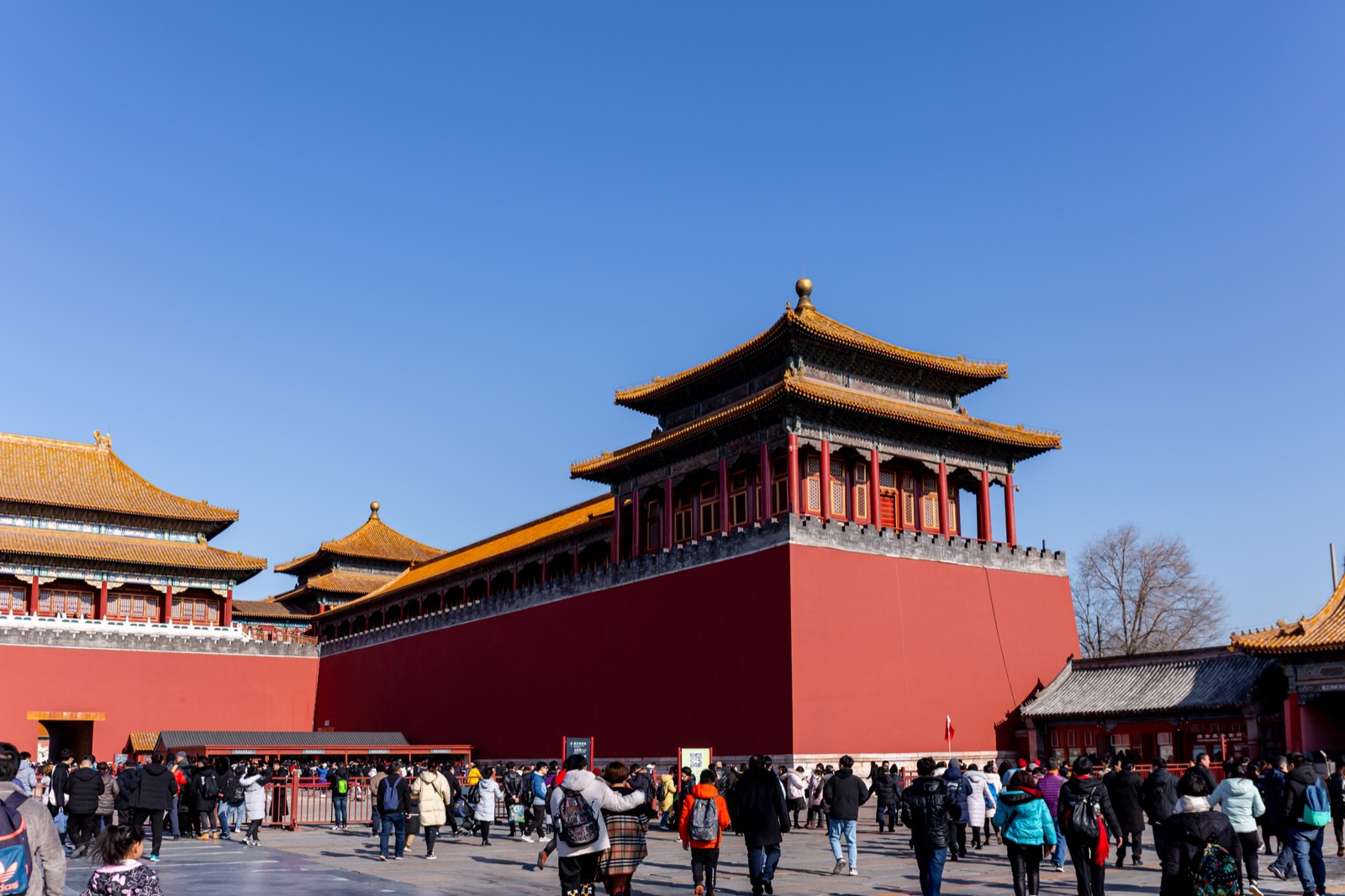
The Forbidden City is not just a palace. It is a spatial argument about imperial order: south-to-north movement, gates, courtyards, halls, hierarchy, and the emperor at the center of the ritual world. For a first visitor, the best approach is not “see every hall.” It is: enter from the south, understand the central axis, move from public ritual space toward inner court life, and exit toward Jingshan for the roofline view.
Tickets: ¥60 peak season (Apr 1 - Oct 31) / ¥40 off-peak (Nov 1 - Mar 31). Treasure Gallery and Clock Gallery additional ¥10 each. Closed Mondays (except national holidays). Tickets released 7 days ahead at 20:00.
Great Wall / 长城
For first-timers, the key decision is not “Great Wall or not.” It is which section fits the traveler:
- Mutianyu / 慕田峪: Strong default for first-time international visitors. ¥45 entry; cable car/chairlift/shuttle bus additional fee (prices vary; verify on-site). On-site ticket purchase available.
- Badaling / 八达岭: Easiest and most famous, but often the busiest.
- Jinshanling / 金山岭: Better for hikers and photographers with more time.
- Huanghuacheng / 黄花城: Interesting for lake views, but needs more planning.
Temple of Heaven / 天坛
Temple of Heaven is the best place to explain ritual China. It is more abstract than the Forbidden City, but it helps visitors understand how emperors performed legitimacy through ceremony. Best paired with morning park life, old Beijing food, and a slower neighborhood walk.
Summer Palace / 颐和园
Summer Palace is best understood as imperial leisure, landscape design, lake scenery, and Qing dynasty court life. It needs time because the site is large. Best paired with a slower day, not a packed museum day.
Hutongs / 胡同
Hutongs should not be treated as a single “old street.” They are neighborhood fabric: courtyard houses, alleys, local shops, food, and daily life. Avoid only the most commercial lanes like Nanluoguxiang main street; wander the side alleys.
Classic Routes
3-day first-timer plan
- Day 1: Forbidden City (enter Meridian Gate, walk central axis, exit north), Jingshan Park for roofline view, hutong walk nearby.
- Day 2: Great Wall day trip (Mutianyu recommended for first-timers).
- Day 3: Temple of Heaven in the morning, Summer Palace in the afternoon, or a museum-focused day.
4-day plan
- Day 1: Forbidden City axis and old Beijing context.
- Day 2: Great Wall day trip.
- Day 3: Temple of Heaven plus hutong/food/local neighborhood route.
- Day 4: Summer Palace, museum, or a slower culture day.
One perfect day in central Beijing
Morning: Enter the Forbidden City at Meridian Gate (south gate). Walk the central axis through the main halls. Exit the north gate. Cross to Jingshan Park for the panoramic roofline view over the Forbidden City. Lunch nearby.
Afternoon: Walk through Beihai Park or wander the hutongs around Nanluoguxiang. Visit the Drum Tower for views over the hutong rooftops.
Evening: Wangfujing snack street for a tourist-friendly introduction to Beijing street food, or Houhai lakeside for a walk around the lake and dinner in a local restaurant.
Hutong and neighborhood route
- Gulou hutongs: Skip the tourist rickshaws and walk yourself. The lanes around the Drum Tower and Bell Tower are best explored on foot without a route.
- 798 Art District: Contemporary art in a decommissioned factory complex. Good for a half-day, especially if interested in Chinese contemporary art.
- Lama Temple (Yonghegong): Active Tibetan Buddhist temple, one of the most impressive in Beijing. Incense is free with entry.
- Panjiayuan Antique Market: Weekend mornings only. A sprawling flea market with everything from genuine antiques to mass-produced Cultural Revolution kitsch. Bargain hard.
Food to Try
- Peking Duck (Beijing kaoya / 北京烤鸭): The iconic dish. Quanjude is touristy and overpriced; try Siji Minfu (四季民福) or Da Dong (大董) for better quality. Reserve ahead.
- Zhajiangmian / 炸酱面: Noodles with soybean paste, minced pork, and vegetable toppings. A cheap, filling local staple available everywhere.
- Jiaozi / 饺子: Dumplings. Try a local dumpling house for a simple, satisfying meal.
- Mongolian hotpot / 淋羊肉: Copper-pot lamb hotpot, a Beijing winter favorite.
- Doujiang/youtiao / 豆浆油条: Soy milk and fried dough sticks — breakfast like a local. Available at any neighborhood breakfast stall.
- Baozi / 包子: Steamed buns, another breakfast staple.
- Avoid: Overpriced “imperial banquets” in tourist areas; they are generally poor value.
Night Experience
- Houhai lakeside: Walk around the lake. Bars vary widely in quality and price; a simple stroll is free and atmospheric.
- Sanlitun: International bars, restaurants, and craft beer. The most Western-style nightlife area.
- Wangfujing Night Market: Touristy but an experience. More spectacle than authentic food.
- Forbidden City moat walk: Walk the perimeter of the Forbidden City (outside the walls) at night. The walls are lit up and it is peaceful compared to the daytime crowds.
Best Time to Visit
- Spring (April-May): Best weather, mild temperatures, cherry blossoms at Yuyuantan Park. Occasional sandstorms in April.
- Summer (June-August): HOT (35C+ common). Start major sights early (by 8am). Spend afternoons indoors (museums, malls). Summer Palace boat rides are a good hot-weather activity.
- Autumn (September-October): Best season — clear skies, comfortable temperatures. Fragrant Hills (Xiangshan) red leaves are famous in late October.
- Winter (November-March): Cold (-5 to 5C), fewer crowds at major sights. Frozen lakes at Houhai/Shichahai for ice skating (late Dec-Feb).
- Golden Week (October 1-7): AVOID if possible — extreme crowds at every sight, hotels at peak prices, trains sell out. If you must travel during this period, book everything weeks ahead.
Culture & History
- Capital for 800+ years across the Yuan, Ming, and Qing dynasties.
- The Forbidden City was built 1406-1420 during the Ming dynasty and was home to 24 emperors.
- The city is organized on a strict north-south ceremonial axis with the Forbidden City at the center; this axis is still visible in the city layout today.
- Hutongs are traditional courtyard neighborhoods, rapidly disappearing due to redevelopment. Many that remain are protected or commercialized.
- The Beijing dialect forms the basis of Standard Mandarin (putonghua).
- Tiananmen Square, south of the Forbidden City, is the world’s largest public square and the symbolic center of modern China.
Accessibility & Tips
- Wheelchair accessibility: Modern sites (National Museum, airports, newer subway stations) are accessible. The Forbidden City has a designated wheelchair route but many halls have steps. The Great Wall is NOT wheelchair accessible.
- For elderly visitors: Major sites involve a LOT of walking. The Forbidden City requires 3-5 km of walking on uneven stone surfaces. Use golf carts and shuttles where available (Mutianyu has cable car). The Great Wall is strenuous and not recommended for those with mobility limitations.
- For families with strollers: Metro stations have elevators but not all exits are accessible. Sidewalks can be uneven. Most parks (Temple of Heaven, Summer Palace) are stroller-friendly on main paths.
- Fitness level required: Moderate to high for a full Beijing trip. Expect 15,000-25,000 steps per day at major sights. Build in rest days.
Common mistakes
- Trying to see the Great Wall, Forbidden City, Summer Palace, and multiple museums in two days.
- Not booking the Forbidden City in advance (tickets are released 7 days ahead and sell out quickly in peak season; walk-up tickets are generally not available).
- Underestimating transfer time across the city.
- Putting the Great Wall on the same day as the Forbidden City.
- Choosing a hotel far from subway lines because the map distance looks short.
- Flying into the wrong airport — Beijing has two airports (PEK and PKX, ~70 km apart). Verify which airport your flight uses.
Sources
- Beijing Municipal Government travel portal: https://english.beijing.gov.cn/travellinginbeijing/
- Forbidden City English: https://en.dpm.org.cn/
- National Museum of China: https://www.chnmuseum.cn/
- Mutianyu Great Wall: https://www.mutianyugreatwall.com/