
Quick answer
Xi’an (pronounced “shee-ahn”, not “ex-ee-an”) is the compact ancient capital stop that makes a first China route feel deeper without adding too many days. It is home to the Terracotta Army (one of the world’s great archaeological sites), one of China’s oldest and best-preserved city walls where you can rent a bicycle and ride the full 13.7km circuit, the atmospheric Muslim Quarter food streets, and Big Wild Goose Pagoda. It sits naturally between Beijing and Shanghai or between Beijing and Chengdu.
Booking warnings
- Terracotta Army (Emperor Qinshihuang’s Mausoleum Site Museum): Advance online booking is recommended. Official site: bmy.com.cn. Foreign passport online booking flow is not independently verified in English; on-site purchase with passport is possible but queues can be long in peak season. ¥120 (Mar 16 - Nov 15 peak season; off-peak pricing may apply).
- Shaanxi History Museum: Free but reservation required; slots are very limited and can be hard to get, especially in peak season. Foreign passport online booking flow is not clearly documented (verify on official channels). Closed most Mondays (except national holidays). Book as early as possible when tickets are released.
- Xi’an City Wall: ¥54. On-site purchase generally available; advance booking recommended for South Gate night visits. Bicycle rental additional fee (~¥45/2hrs single, ~¥90 tandem; prices may vary).
- Many museums are closed on Mondays (except national holidays).
- Summer (July-August) in Xi’an is very hot (often 35-40C); plan accordingly.
Best Areas to Stay
- Inside City Wall / Bell Tower area: The most convenient location for tourists. Walkable to the Muslim Quarter, City Wall (South Gate), Bell Tower, and Drum Tower. Most hotels are here, from budget to upscale. Metro Lines 2 and 4.
- Big Wild Goose Pagoda / Qujiang: Newer area south of the wall, with upscale hotels, near Big Wild Goose Pagoda and Tang Paradise (Datang Furong Garden). Good if you prefer newer areas.
- High-tech zone: Business hotels, farther from historic sights; not ideal for tourists.
- Budget tip: Stay near a subway station. Lines 2 (north-south) and 4 are most useful for reaching major sights.
Arrival & Transport
- Airport XIY (Xianyang International) is ~40 km northwest of the city, approximately 45-60 minutes by airport bus or Metro Line 14 (times vary depending on traffic and exact destination).
- Xi’an North Railway Station: Main HSR station (to Beijing ~4.5hrs, Chengdu ~3-4hrs, Luoyang ~1.5hrs). Metro Line 2 connects directly to the city center (~30 min).
- Xi’an Station: Older conventional train station, closer to the city wall but fewer high-speed services.
- Metro covers major sights; ¥2-7 per trip.
- To the Terracotta Army: Tourist Bus 5 (游5/306) departs from Xi’an Railway Station (east side), takes approximately 1 hour, costs around ¥7. Buses are generally frequent but wait times can vary. Alternatively, Didi/taxi costs approximately ¥150 one way to the site. Ignore fake “Terracotta Army” tour offers from people at stations.
- Didi is widely used within the city. Taxis start at approximately ¥9-10 flagfall (verify current rates).
Top Sights
Terracotta Army / 秦始皇兵马俑
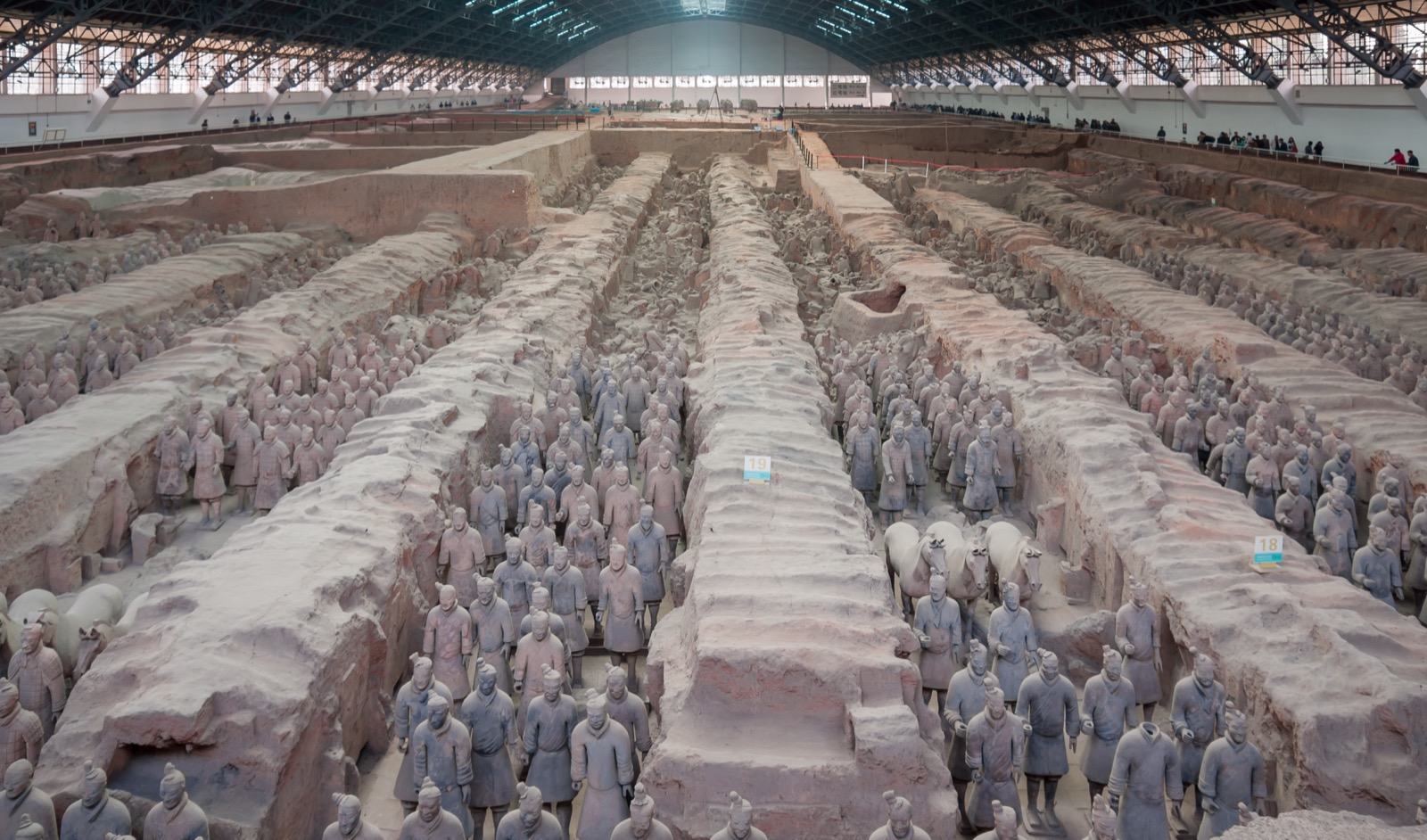
One of the greatest archaeological discoveries of the 20th century: thousands of life-sized clay soldiers, archers, and horses guarding the tomb of Qin Shi Huang (China’s first emperor, d. 210 BCE). Three main pits; Pit 1 is the largest and most impressive (the one you see in photos). Allow 3-4 hours minimum. ¥120. Pit 1 has wheelchair access; other pits have limited access. Located 40 km east of Xi’an — plan a full morning or afternoon.
Xi’an City Wall / 西安城墙
One of China’s oldest, largest, and best-preserved city walls (Ming dynasty, 14th century). The full circuit is 13.7 km. Rent a bicycle (¥45/2hrs for single, ¥90 for tandem) to ride the wall — one of Xi’an’s best activities. Electric carts also available (¥80-120). South Gate has ramp access; some gates accessible for wheelchairs. The wall is lit at night and some sections are open for evening visits. ¥54.
Muslim Quarter / 回民街
A network of narrow lanes behind (north of) the Drum Tower with some of China’s best street food. Extremely atmospheric but also extremely crowded. The main street (Huimin Jie) is touristy; walk deeper into the side lanes (Dapiyuan, Xiyangshi) for better food. Narrow lanes, crowded, not accessible for wheelchairs. Free to enter; pay for what you eat.
Big Wild Goose Pagoda / 大雁塔
A 7-story pagoda built in 652 CE during the Tang dynasty, originally to house Buddhist scriptures brought back from India by the monk Xuanzang. The temple grounds (Daci’en Temple) are approximately ¥50 (peak season; off-peak may be lower, verify on arrival); pagoda climb is an additional ¥30 (narrow steep stairs; sold on-site). Best visited in the late afternoon. The North Square has a large fountain show in the evenings (free; times vary seasonally).
Shaanxi History Museum / 陕西历史博物馆
One of China’s best provincial museums, covering Shaanxi’s 1,000+ years as imperial capital. Free but reservation required — and slots are very limited, especially in peak season. Book as soon as tickets are released (typically 1-7 days ahead). Closed most Mondays (except national holidays).
Small Wild Goose Pagoda / 小雁塔
A smaller, less crowded pagoda from 707 CE, set in a pleasant park with the ancient Xi’an Museum (free). Good alternative if Big Wild Goose is too crowded.
Classic Routes
One perfect day
Morning: City Wall bicycle ride (enter South Gate, ride east to North Gate or full circuit, 1.5-2.5 hours). Go early before it gets hot.
Lunch: Muslim Quarter — walk the lanes behind the Drum Tower. Try multiple stalls.
Afternoon: Take the tourist bus or Didi to the Terracotta Army (40km, ~1hr). Spend 3-4 hours at the pits. Return to Xi’an by early evening.
Evening: Grand Tang Mall (Datang Buyecheng) near Big Wild Goose Pagoda — Tang-themed pedestrian street lit up at night with performances.
2 days
- Day 1: City Wall bicycle ride (morning) → Forest of Steles Museum (calligraphy, optional) → Muslim Quarter for lunch → Shaanxi History Museum (if booked) → Big Wild Goose Pagoda and Grand Tang Mall at night.
- Day 2: Terracotta Army (full morning/afternoon) → optional: Huaqing Palace (near Terracotta Army) or return to city.
3 days
Add a day trip: Qianling Mausoleum (Tang dynasty tombs with remarkable stone carvings) or Famen Temple (Buddhist relic temple).
Food to Try
Xi’an’s food scene is one of China’s greatest, influenced by its position at the eastern end of the Silk Road and centuries of Muslim (Hui) community presence.
- Roujiamo (肉夹馍): Often called “Chinese hamburger” — braised, spiced pork (or beef/lamb in Muslim Quarter) chopped and stuffed into a flatbread. Cheap, filling, everywhere.
- Biangbiang noodles (biangbiang mian / biangbiang面): Wide, hand-pulled noodles, named for the famously complex Chinese character (impossible to type; look for the sign). Served with chili oil, garlic, and vinegar.
- Yangrou paomo (羊肉泡馍): Lamb stew with crumbled unleavened bread. The ritual is that you tear the bread into small pieces yourself before they pour the hot broth over it. Try at Lao Tong Jia or Lao Sun Jia (famous old restaurants).
- Liangpi (凉皮): “Cold skin noodles” — chewy wheat or rice noodles served cold with chili oil, vinegar, and cucumber. Refreshing in summer.
- Muslim Quarter street food: Persimmon cakes (shibing / 柿饼, seasonal), grilled lamb skewers, sweet osmanthus rice cakes, pomegranate juice (famous in Xi’an), beef noodles. Try multiple stalls; avoid the very first ones on the main tourist street.
- Guantang baozi: Soup dumplings (similar to xiaolongbao but Xi’an-style, served in a bamboo steamer).
Night Experience
- City Wall at night: The wall is beautifully illuminated. The South Gate area is open for night visits (check seasonal hours). A night walk or short bicycle ride is very atmospheric.
- Grand Tang Mall (Datang Buyecheng / 大唐不夜城): A large Tang-themed pedestrian street south of Big Wild Goose Pagoda, lit up with Tang-style lanterns and architecture. Free. Performances, street vendors, and a festive atmosphere every evening.
- Muslim Quarter night food stalls: The Quarter comes alive at night with food stalls packed with locals and tourists. Crowded but atmospheric.
- Big Wild Goose Pagoda North Square fountain show: Free evening fountain/music show (times vary seasonally; typically 20:00-20:20 in summer). Very popular with Chinese tourists.
Best Time to Visit
- Spring (April-May): Mild temperatures (15-28C), best weather overall.
- Autumn (September-October): Clear skies, comfortable temperatures (15-25C). Another excellent season.
- Summer (June-August): VERY hot (35-40C daily). Avoid if possible; start sightseeing at 8am and spend afternoons indoors.
- Winter (November-March): Cold (0-5C), fewer crowds, grey skies. The City Wall can be beautiful in light snow but biking is not comfortable.
Culture & History
- Capital for 13 dynasties: Xi’an (ancient Chang’an) was the capital of China for over 1,100 years, including the Qin, Han, Sui, and Tang dynasties — arguably the most important city in Chinese history.
- Starting point of the Silk Road: Chang’an was the eastern terminus of the Silk Road trade routes connecting China to Central Asia, the Middle East, and Europe for 2,000 years.
- Terracotta Army: Built for Qin Shi Huang (259-210 BCE), the first emperor to unify China. The army was discovered in 1974 by farmers digging a well. It is estimated to contain 8,000+ soldiers, 130 chariots, and 670 horses, each with unique facial features.
- Tang dynasty (618-907 CE): Chang’an was the world’s largest city (population ~1 million) and a cosmopolitan center of trade, religion (Buddhism flourished), art, and poetry. Big Wild Goose Pagoda dates from this era.
- City Wall: Built during the Ming dynasty (14th century) on earlier foundations, it stands 12m high and 15-18m wide at the top. It is one of the few Chinese city walls that survived 20th-century demolition.
- Muslim Quarter: Reflects centuries of Silk Road and Islamic heritage in Xi’an. The Hui Muslim community has lived here since at least the Ming dynasty.
Accessibility & Tips
- City Wall: South Gate has ramp access; wall top is accessible for wheelchairs at some gates. Bicycle rental is not accessible. Electric carts are an option.
- Terracotta Army: Pit 1 has wheelchair access; other pits may have limited access. Golf cart shuttles between pits available for a fee. The site requires 3-4 hours of walking on hard surfaces.
- Muslim Quarter: Narrow lanes, crowded, uneven stone surfaces. NOT accessible for wheelchairs or strollers.
- Big Wild Goose Pagoda: Temple grounds are flat; pagoda interior has narrow steep stairs.
- Bicycle ride on City Wall is 13.7km — a significant ride; allow 1.5-2 hours for a partial circuit if not doing the full loop.
- Fitness: Moderate to high. Terracotta Army involves 3-4 hours of walking on hard museum floors. City Wall cycling is fun but requires basic fitness. Expect 12,000-20,000 steps/day.
Common mistakes
- Trying to do the Terracotta Army in 2 hours — you need 3-4 minimum to see all three pits properly. Many visitors rush through and miss Pits 2 and 3.
- Taking fake “Terracotta Army” tours from random people at train stations or bus stops. They take you to fake sites or overcharge. Use the official Tourist Bus 5 from Xi’an Railway Station.
- Eating only at the most touristy end of the Muslim Quarter (the first 100m of Huimin Jie). Walk deeper into the side lanes (Dapiyuan, Xiyangshi) for better, cheaper food.
- Visiting in July-August heat without preparing. 38-40C is common. Start early, carry water, use sun protection.
- Skipping the City Wall bicycle ride — it is one of the most unique and enjoyable activities in all of China.
- Confusing Xi’an Railway Station and Xi’an North — most HSR trains use Xi’an North; Tourist Bus 5 to Terracotta Army departs from Xi’an Station (the old one).
Sources
- Terracotta Army: https://www.bmy.com.cn/